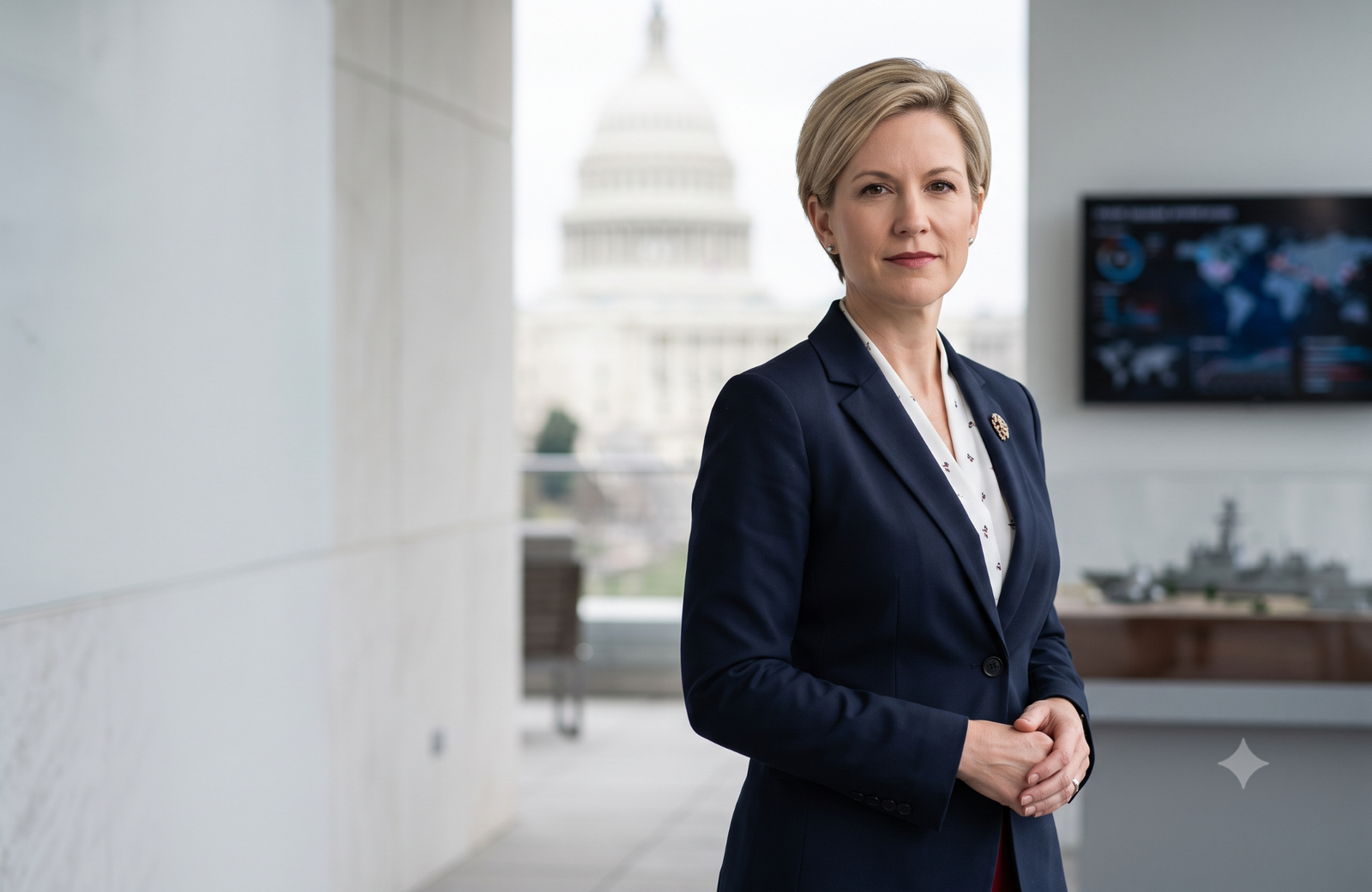
Rebeccah Heinrichs Biography: Age, Career & Net Worth
Rebeccah Heinrichs is an American national security specialist known for her work on nuclear deterrence, missile defense, arms control, military readiness, and United States defense policy. She is a senior fellow at Hudson Institute and directs its Keystone Defense Initiative. She has also taught nuclear deterrence theory and served on major national security advisory bodies.
Many readers search for Rebeccah Heinrichs’ age and net worth after seeing her on television, at policy events, or in congressional discussions. However, two of the most commonly repeated details about her are not publicly verified. No reliable primary source provides her date of birth, exact age, height, salary, assets, or personal net worth.
This profile separates confirmed information from guesses. It covers her education, congressional experience, Hudson Institute work, doctorate, teaching, book, family, public influence, and the limits of online net worth estimates.
Rebeccah Heinrichs Quick Facts
The following table presents details supported by institutional, university, congressional, or professional sources. Where reliable information is unavailable, it is marked as not publicly confirmed.
| Fact | Verified information |
| Professional name | Rebeccah L. Heinrichs |
| Full name in university records | Rebeccah Leigh Heinrichs |
| Date of birth | Estimated 1986–1987 |
| Current age | 38–39 |
| Birthplace | America |
| Nationality | American |
| Profession | National security analyst, policy scholar, educator, author |
| Current main role | Senior fellow at Hudson Institute |
| Leadership role | Director of the Keystone Defense Initiative |
| Main subjects | Strategic deterrence, missile defense, nuclear policy, arms control |
| Undergraduate education | BA in history and political science from Ashland University |
| Master’s education | MA in national security and strategic studies from the US Naval War College |
| Doctorate | Doctor of Defense and Strategic Studies from Missouri State University |
| Teaching work | Adjunct professor teaching nuclear deterrence theory |
| Published book | Duty to Deter |
| Marital status | Married |
| Children | Five |
| Residence | Virginia |
| Height | Not publicly confirmed |
| Net worth | No reliable public estimate |
Hudson Institute uses the professional name Rebeccah L. Heinrichs. Missouri State University’s Spring 2024 graduate record lists her as Rebeccah Leigh Heinrichs and confirms that she received a Doctor of Defense and Strategic Studies.
Who Is Rebeccah Heinrichs?
Rebeccah Heinrichs is a policy scholar whose work focuses on how the United States can prevent war, defend its territory, maintain credible military strength, and respond to nuclear threats. Her public profile comes from policy research, congressional experience, university teaching, advisory work, writing, and frequent media commentary.
She is not primarily an entertainment celebrity. Her recognition comes from appearing in serious discussions about nuclear weapons, missile defense, military strategy, China, Russia, Iran, North Korea, NATO, and the readiness of the American armed forces.
Hudson Institute identifies her as a senior fellow and director of the Keystone Defense Initiative. The institute describes her main specialty as United States national defense policy, with particular attention to strategic deterrence. She also works across areas such as arms control, nonproliferation, missile defense, and foreign policy.
In simple terms, deterrence means convincing an opponent that starting an attack would bring unacceptable costs or would fail to achieve its goal. Heinrichs studies how military capabilities, alliances, nuclear forces, missile defenses, political credibility, and clear communication can reduce the chance of war.
How Old Is Rebeccah Heinrichs?
Rebeccah Heinrichs’ exact age is not publicly confirmed. Her official Hudson Institute biography, congressional biography, university records, Senate committee profile, and professional event pages do not provide a date of birth or birth year. Without a reliable birth date, her current age cannot be calculated accurately.
Some online biography websites present estimated or claimed ages. These figures should not be treated as established facts because they conflict with one another and do not cite a birth certificate, official biography, direct interview, or verified personal statement.
For example, one page estimates that she was born in 1986 or 1987. Another claims a July 9, 1982 birth date while presenting an age that does not match that year. A different page places her birth around 1967. The large differences show that these pages are repeating guesses rather than a verified record.
Why are there so many conflicting age claims?
Online celebrity websites often try to complete every field in a biography, even when the subject has not made that information public. One site may create an estimate based on appearance, education, or career history. Other sites then repeat the number without checking its origin.
That process can make an unsupported claim appear widely accepted. Repetition does not turn an estimate into a fact. A trustworthy profile should therefore say that Rebeccah Heinrichs’ age remains private or unverified. It should not calculate her age from an assumed birth year.
Does her career timeline reveal her age?
Her professional timeline can show that she has substantial experience, but it cannot prove her birth date. Public sources confirm that she completed undergraduate and graduate education, worked in Congress, became a senior policy scholar, taught graduate students, joined national advisory bodies, completed a doctorate, and published a book.
None of those milestones provides enough information to determine her exact age. College attendance also cannot establish a birth year. People begin undergraduate or graduate programs at different ages, take career breaks, return to education later, or complete degrees while employed.
A Career Built Around National Security Policy
Rebeccah Heinrichs’ career is better understood as a combination of government experience, policy research, teaching, public communication, and strategic advisory work.
Unlike a traditional academic who works mainly inside a university, Heinrichs has moved between several parts of the national security community. Her experience includes congressional work, think tank research, military policy discussions, public testimony, advisory panels, classroom teaching, writing, and television analysis.
Early work in the US House of Representatives
Before becoming widely known through Hudson Institute and media appearances, Heinrichs worked in the United States House of Representatives.
The National Defense Industrial Association states that she served as an adviser to former Representative Trent Franks of Arizona. Her work covered issues connected to the Strategic Forces Subcommittee of the House Armed Services Committee. She also helped establish the Bipartisan Missile Defense Caucus. Before focusing on defense policy, she worked on the oversight staff of the House Judiciary Committee.
The Senate Armed Services Committee similarly notes that she advised Representative Franks on national security and foreign policy and helped launch the bipartisan missile defense group.
This congressional experience is important because it exposed her to the practical side of policy. National security decisions do not depend only on academic theories. They also involve budgets, legislation, hearings, military requirements, executive agencies, political negotiations, and communication between Congress and the Department of Defense.
Joining Hudson Institute
Heinrichs later became a senior fellow at Hudson Institute, a Washington based policy organization. Her work there centers on strategic deterrence and other major defense questions.
She also leads the Keystone Defense Initiative. The initiative provides a platform for research and discussion involving defense officials, military leaders, members of Congress, analysts, industry representatives, and specialists in emerging security challenges.
As director, Heinrichs participates in research, hosts or moderates policy events, publishes analysis, interviews decision makers, and contributes to public debates about American military strategy. Hudson continues to list her as senior fellow and director as of August 2026.
National advisory and commission work
Heinrichs has held roles that go beyond commentary. She served as a commissioner on the bipartisan Congressional Commission on the Strategic Posture of the United States. The commission was established through the Fiscal Year 2022 National Defense Authorization Act to review the country’s strategic military posture. The Senate Armed Services Committee publicly announced her selection for the commission in March 2022.
The commission examined questions involving nuclear forces, deterrence, missile defense, arms control, threats from major powers, and the ability of the United States to respond to a changing security environment. Its final report was issued in 2023, with Heinrichs named among the commissioners.
Hudson Institute also reports that she serves on the US Strategic Command Advisory Group and the National Independent Panel on Military Service and Readiness. These assignments distinguish her from commentators whose work is limited to media appearances. They show direct involvement in formal policy review and advisory processes.
The Education Behind Her Policy Work
Rebeccah Heinrichs’ education combines political history, national security studies, military strategy, and doctoral research. Her academic path did not remain limited to one degree or one institution. She continued studying while building a professional career, eventually earning a practice focused doctorate in defense and strategic studies.
Ashland University
Heinrichs earned a Bachelor of Arts in history and political science from Ashland University in Ohio. She also participated in the Ashbrook Scholar Program. Hudson Institute reports that she later became a member of Ashland University’s Board of Trustees.
History and political science provide a useful base for national security work. History helps analysts compare current crises with earlier wars, diplomatic failures, alliances, arms competitions, and political movements. Political science provides tools for studying institutions, state behavior, government authority, decision making, and international relations.
The Ashbrook program is known for emphasizing American history, constitutional government, political thought, and civic leadership. Heinrichs’ later work on Congress, executive power, military policy, and the ethical use of force connects naturally with those subjects.
US Naval War College
She earned a Master of Arts in national security and strategic studies from the United States Naval War College. According to Hudson Institute and the National Defense Industrial Association, she graduated with highest distinction from the College of Naval Command and Staff. She also received the Director’s Award for academic excellence.
The Naval War College education strengthened her knowledge of military planning, national strategy, conflict, deterrence, and the relationship between political objectives and military power.
This qualification is often shortened incorrectly on biography sites. It is more accurate to state that she earned an MA in national security and strategic studies and completed the College of Naval Command and Staff with highest distinction.
Doctorate from Missouri State University
Earlier congressional records stated that Heinrichs was pursuing a doctorate in defense and strategic studies at Missouri State University.
She later completed the program. Missouri State University’s official Spring 2024 graduate list records Rebeccah Leigh Heinrichs as receiving a Doctor of Defense and Strategic Studies. Hudson Institute now refers to her as Dr. Heinrichs and states that she completed the doctorate with distinction.
This is one area where older profiles may be outdated. Pages written before her graduation may still describe her as a doctoral student. Current profiles should state that the doctorate has been completed.
What Does Rebeccah Heinrichs Specialize In?
Her work covers several connected areas of national defense.
Strategic deterrence
Strategic deterrence is the central theme in her public biography. It concerns the policies and military capabilities used to discourage major attacks against the United States and its allies.
Deterrence can involve nuclear forces, conventional military power, missile defenses, alliances, intelligence, cyber capabilities, space systems, economic tools, and clear warnings about the consequences of aggression.
Heinrichs often argues from the position that deterrence must be credible. An opponent must believe that the United States has both the ability and political will to respond.
Nuclear policy
Nuclear strategy is one of her most visible areas of work.
This includes questions such as:
- Why countries maintain nuclear weapons
- How nuclear forces may prevent large wars
- Whether the United States has enough capacity to deter more than one major nuclear power
- How aging nuclear systems should be modernized
- What moral limits should apply to deterrence
- How arms control should respond to changing threats
Her teaching and writing often connect military strategy with ethical questions rather than treating nuclear policy as a purely technical subject.
Missile defense
Missile defense has been part of Heinrichs’ work since her time in Congress.
Missile defense systems are designed to detect, track, and intercept threatening missiles. Policy debates involve the number and location of interceptors, protection of the American homeland, defense of military forces, regional systems for allies, costs, technical reliability, and possible reactions from adversaries.
Her role in helping launch the Bipartisan Missile Defense Caucus shows that this subject was a significant part of her congressional work.
Arms control and nonproliferation
Heinrichs also comments on arms control agreements and efforts to prevent the spread of nuclear weapons. Arms control concerns negotiated restrictions, transparency measures, verification, or limits on particular weapons. Nonproliferation focuses on preventing additional states or nonstate groups from acquiring nuclear capabilities.
Her work often examines whether an agreement reflects current threats, whether the other party follows its obligations, and whether restrictions improve or weaken American security.
Military readiness
Her service on the National Independent Panel on Military Service and Readiness connects her work with a broader set of defense concerns.
Readiness includes whether the armed forces have enough trained personnel, modern equipment, ammunition, maintenance capacity, industrial support, leadership, and operational preparation to carry out assigned missions.
Teaching, Writing and Media Work
Rebeccah Heinrichs’ public influence does not come from one position alone. She communicates with several different audiences.
Teaching nuclear deterrence theory
She has served as an adjunct professor at the Institute of World Politics, where she teaches nuclear deterrence theory.
The institute’s course description states that students examine the purpose of United States nuclear weapons, competing schools of deterrence theory, possible strategies, risks, costs, and outcomes. Students are expected to compare different arguments rather than accept a single theory without criticism.
Teaching allows Heinrichs to turn policy experience into structured academic instruction. It also places her in contact with students preparing for work in government, intelligence, diplomacy, military service, policy research, and related fields.
Publications and commentary
Hudson Institute publishes her research, testimony, commentary, podcast appearances, media interviews, and event discussions. She has also written for political and foreign policy publications and serves as a contributing editor for Providence: A Journal of Christianity and American Foreign Policy.
Her writing commonly addresses deterrence, military modernization, nuclear threats, missile defense, alliances, conflict escalation, and the moral responsibilities involved in national defense.
Television and public appearances
Heinrichs regularly appears on television, radio, podcasts, congressional panels, university programs, and policy events. C SPAN lists numerous appearances involving her work as Hudson Institute’s Keystone Defense Initiative director and senior fellow.
Media appearances make highly technical subjects more accessible to the public. They also explain why people outside policy circles increasingly search for details about her age, family, background, and net worth.
Rebeccah Heinrichs’ Book
Rebeccah Heinrichs is the author of Duty to Deter: American Nuclear Deterrence and the Just War Doctrine. The book examines whether nuclear deterrence can be evaluated through just war principles. Instead of discussing nuclear weapons only through military capability or international politics, it considers the moral duties of political leaders responsible for protecting a country and preventing catastrophic conflict.
Hudson Institute hosted an event about the book in October 2024. Retail and publisher information lists it as a 2024 publication from the National Institute for Public Policy. The subject reflects a distinctive part of Heinrichs’ work. She frequently connects national security with moral judgment, political responsibility, human life, and the ethical consequences of weakness as well as force.
Her argument is not simply that more weapons are always better. The central issue is whether a credible deterrent can prevent aggression and protect innocent life when potential opponents possess powerful weapons of their own.
Rebeccah Heinrichs Net Worth
Rebeccah Heinrichs’ net worth is not publicly known. No audited statement, court record, official financial disclosure, company filing, verified interview, or credible financial publication provides a confirmed figure for her assets and liabilities.
Some celebrity websites may attach a number to her name, but those figures do not explain the value of her property, savings, investments, retirement accounts, debts, book royalties, compensation, or other financial interests. For that reason, presenting an exact Rebeccah Heinrichs net worth estimate would create a false sense of accuracy.
Why a reliable net worth estimate is not available
Net worth is calculated by subtracting liabilities from assets:
Net worth equals total assets minus total debts.
To make a meaningful estimate, a researcher would need reliable information about items such as:
- Real estate ownership and mortgage balances
- Bank and investment accounts
- Retirement savings
- Business ownership
- Book contracts and royalties
- Other property
- Personal loans and liabilities
- Household financial arrangements
None of this information is provided in her official professional biographies. A person’s job title also does not reveal personal wealth. Two senior fellows with similar careers can have very different finances because of age, household income, investments, property, inheritance, debt, spending, and previous employment.
Possible professional income channels
Her public career suggests several possible sources of professional income, but the amounts and contractual arrangements are private.
| Possible income category | What is publicly known |
| Think tank employment | She is a senior fellow and initiative director at Hudson Institute |
| University teaching | She has taught nuclear deterrence as an adjunct professor |
| Writing | She publishes articles and policy analysis |
| Book income | She is the author of Duty to Deter |
| Speaking | She appears at conferences, universities, and policy events |
| Media work | She provides television, radio, and podcast commentary |
| Advisory work | She serves on public policy groups, though payment is not established |
It should not be assumed that every appearance or advisory role is paid. Television interviews may be unpaid expert commentary. Government commissions may offer limited compensation, reimbursement, or no meaningful personal income. Book royalties vary widely and cannot be calculated from a retail price alone.
Can her net worth be estimated from a Hudson Institute salary?
No reliable personal net worth can be calculated from an assumed Hudson Institute salary. Public nonprofit filings may disclose compensation for selected senior officers and highly compensated employees, but they do not necessarily show every employee’s salary. Even an accurate annual salary would represent income, not wealth.
Income is the money someone receives during a period. Net worth is the combined value of accumulated assets minus liabilities. Confusing the two is one of the main reasons online celebrity estimates become misleading.
Are online million dollar estimates credible?
Not unless the publisher provides evidence. A credible estimate should identify the records used, explain the calculation, separate household wealth from individual wealth, account for liabilities, and provide a realistic range. Most biography pages do none of these things.
The responsible answer is therefore that Rebeccah Heinrichs’ net worth remains private and cannot be verified from available public information.
Husband, Children and Personal Life
Rebeccah Heinrichs is married and has five children. Hudson Institute states that she lives in Virginia with her husband and their five children. The National Defense Industrial Association provides the same basic family information.
Reliable institutional biographies do not provide extensive information about her husband or children. They do not identify every family member, describe their private lives, or publish personal details unrelated to her work. That boundary should be respected. Her spouse and children do not need to become public figures simply because she appears on television or participates in national security debates.
Is Rebeccah Heinrichs’ husband publicly identified?
Her official biographies confirm that she is married, but the main sources used for this profile do not provide a verified public name for her husband.
Some biography websites may publish names or personal claims without showing where the information came from. Such details should not be repeated as fact without a direct statement, established interview, verified profile, or reliable public record that is relevant and appropriate to use.
Height and Physical Appearance
Rebeccah Heinrichs’ height is not reliably documented. No official Hudson Institute biography, congressional profile, university record, or established professional source gives a verified height. Numbers found on general biography pages should therefore be treated as unconfirmed.
Height has no meaningful connection to her qualifications or policy work. It is mainly searched because celebrity profile formats often encourage readers to expect physical measurements for every public figure.
Current Role and Recent Activity
As of August 2026, Hudson Institute continues to list Dr. Rebeccah Heinrichs as senior fellow and director of the Keystone Defense Initiative. Her recent public work has included policy discussions, interviews, commentary, and Hudson events involving nuclear strategy, NATO, American military power, Iran, Ukraine, missile defense, defense production, and relations with major powers.
Hudson’s activity record shows that she continued appearing in media and hosting policy discussions throughout 2026. It also lists meetings with elected officials, defense leaders, scholars, and military policy specialists.
Her career therefore remains active rather than historical. Older pages that describe only her early Hudson role, congressional work, or incomplete doctoral studies do not present her current professional status accurately.
What Makes Her Career Different From a Typical Media Commentator?
Rebeccah Heinrichs combines several types of experience that are often separated. She has worked within Congress, studied at a military graduate institution, completed a doctorate, taught deterrence theory, directed a defense initiative, participated in a congressional commission, joined advisory groups, published research, written a book, and communicated through national media. This combination matters because defense policy has several layers.
Academic knowledge helps explain theories and historical cases. Government experience shows how policy decisions are made. Advisory work involves evaluating real national requirements. Teaching requires ideas to be organized and defended. Media work demands clear explanations for audiences who may not know technical terminology. Her public role sits at the point where these different activities meet.
Verified Facts About Rebeccah Heinrichs
Several details stand out when unreliable age and net worth claims are removed. First, her correct professional spelling is Rebeccah, with an “h” at the end. Search results often misspell it as Rebecca Heinrichs. Second, her full name appears as Rebeccah Leigh Heinrichs in Missouri State University’s official graduation record. Professionally, she normally uses Rebeccah L. Heinrichs.
Third, she completed her Doctor of Defense and Strategic Studies in 2024. Earlier records describing her as a doctoral student were accurate at the time but are now outdated. Fourth, her public work is not limited to television. She has held congressional, academic, research, commission, and advisory responsibilities.
Fifth, she is an author. Her book addresses both the strategic and moral dimensions of American nuclear deterrence. Finally, her exact birth date, age, height, salary, and net worth remain unverified. A responsible biography should not fill these gaps with unsupported numbers.
Frequently Asked Questions About Rebeccah Heinrichs
How old is Rebeccah Heinrichs?
Rebeccah Heinrichs’ exact age is not publicly confirmed. Reliable institutional and government biographies do not list her date of birth or birth year. Online age estimates conflict and should not be presented as verified facts.
What is Rebeccah Heinrichs famous for?
She is known for her work on United States national security, strategic deterrence, nuclear policy, missile defense, arms control, and military readiness. She is a senior fellow at Hudson Institute and directs its Keystone Defense Initiative.
What is Rebeccah Heinrichs’ net worth?
Her net worth is not publicly known. No credible financial record provides enough information about her assets, debts, investments, property, or earnings to calculate a reliable figure.
Where did Rebeccah Heinrichs go to college?
She earned a BA in history and political science from Ashland University, an MA in national security and strategic studies from the US Naval War College, and a Doctor of Defense and Strategic Studies from Missouri State University.
Does Rebeccah Heinrichs have a doctorate?
Yes. Missouri State University’s Spring 2024 graduate record confirms that Rebeccah Leigh Heinrichs received a Doctor of Defense and Strategic Studies. Hudson Institute states that she graduated with distinction.
Is Rebeccah Heinrichs married?
Yes. Official professional biographies state that she lives in Virginia with her husband and their five children.
What does Rebeccah Heinrichs do for a living?
She works as a national security scholar, senior fellow, defense initiative director, educator, writer, author, adviser, and media commentator. Her principal publicly listed position is at Hudson Institute.
What book did Rebeccah Heinrichs write?
She wrote Duty to Deter: American Nuclear Deterrence and the Just War Doctrine. The book discusses the morality and strategic purpose of nuclear deterrence.
How tall is Rebeccah Heinrichs?
Her height has not been reliably published by an official or established professional source. Any exact measurement appearing on general biography websites should be treated as unverified.
Is Rebeccah Heinrichs still at Hudson Institute?
Yes. As of August 2026, Hudson Institute lists her as a senior fellow and director of the Keystone Defense Initiative.
Final Thoughts
Rebeccah Heinrichs has built a public career around some of the most serious questions in American defense policy. Her background includes congressional service, advanced strategic education, university teaching, think tank leadership, national advisory work, media analysis, and authorship.
The most reliable answer to questions about Rebeccah Heinrichs’ age and net worth is also the most cautious one. Neither figure has been publicly verified. Her date of birth remains private, and available records do not support a responsible personal wealth estimate.
What can be confirmed is her professional record: she directs the Keystone Defense Initiative, holds a doctorate in defense and strategic studies, has served on major policy bodies, and remains active in national security discussions.